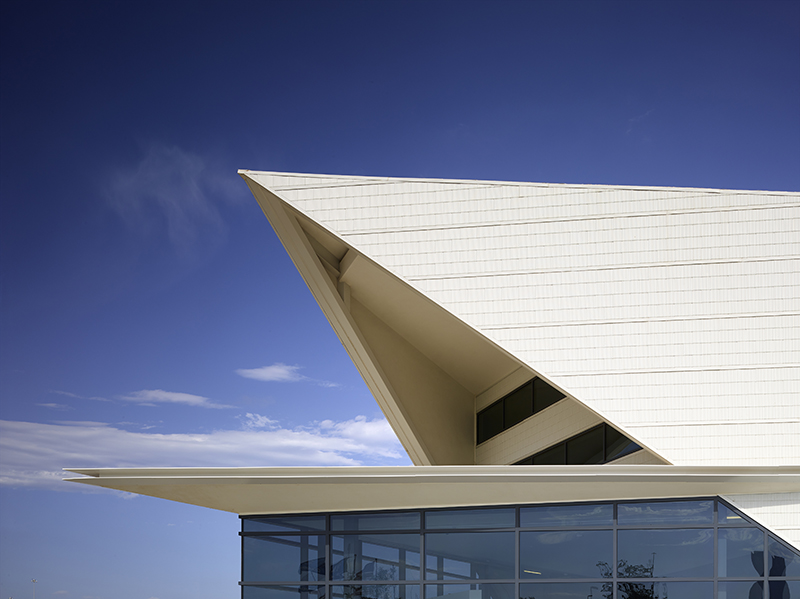
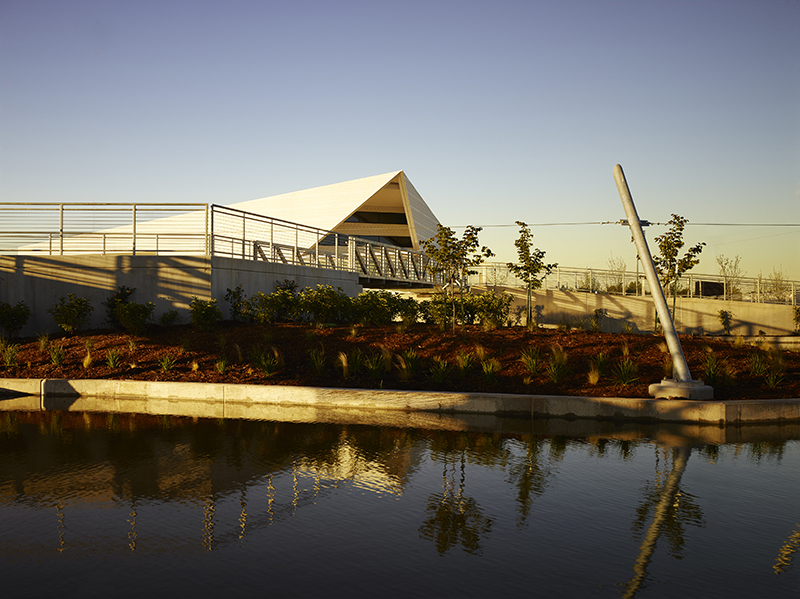
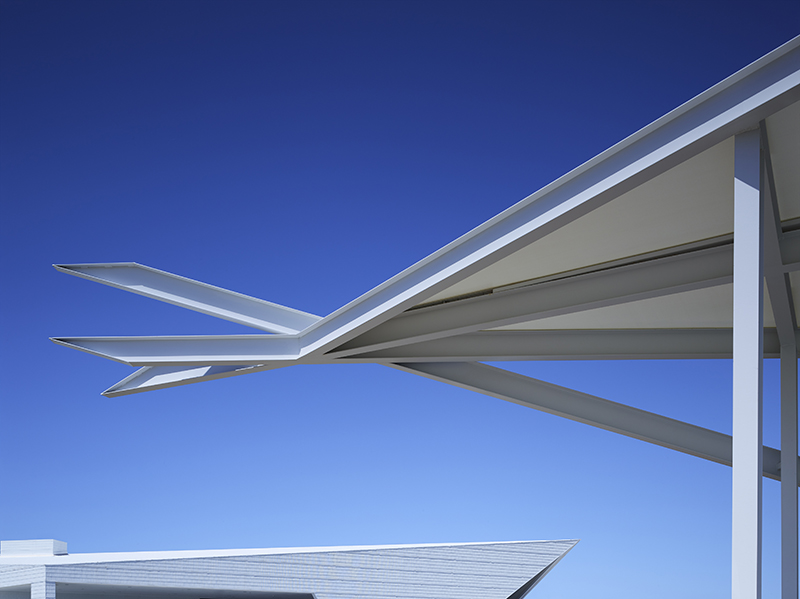
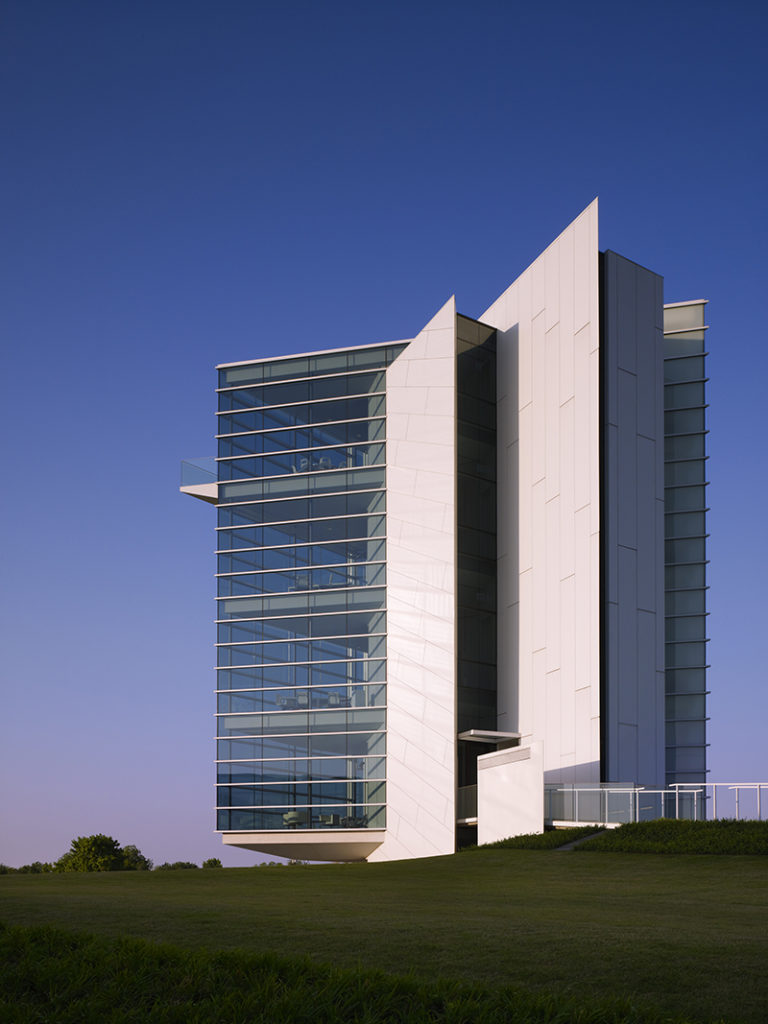
Rand Elliott Architects’ design concepts for the Oklahoma River’s Riversport OKC complex expand on the Boathouse District aesthetic defined in Elliott’s first sketches of the Chesapeake Boathouse (2003). Yet these forms reflect the roaring nature of Riversport OKC, embracing its furiously churning power. So, the architecture here projects a high-energy angularity.
Like the Oklahoma River’s flatwater sports, Riversport OKC challenges riders to lean in, forge ahead and finish fast. (Raft and tube riders can relax and just enjoy.) Either way, there’s no staying dry.
The rapids course itself is a rarity; there are only four like it in the world.
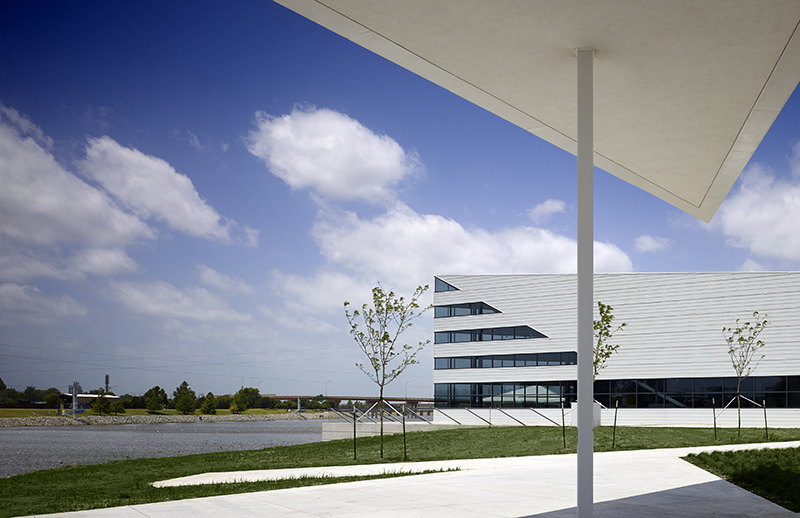
McClendon Whitewater Center
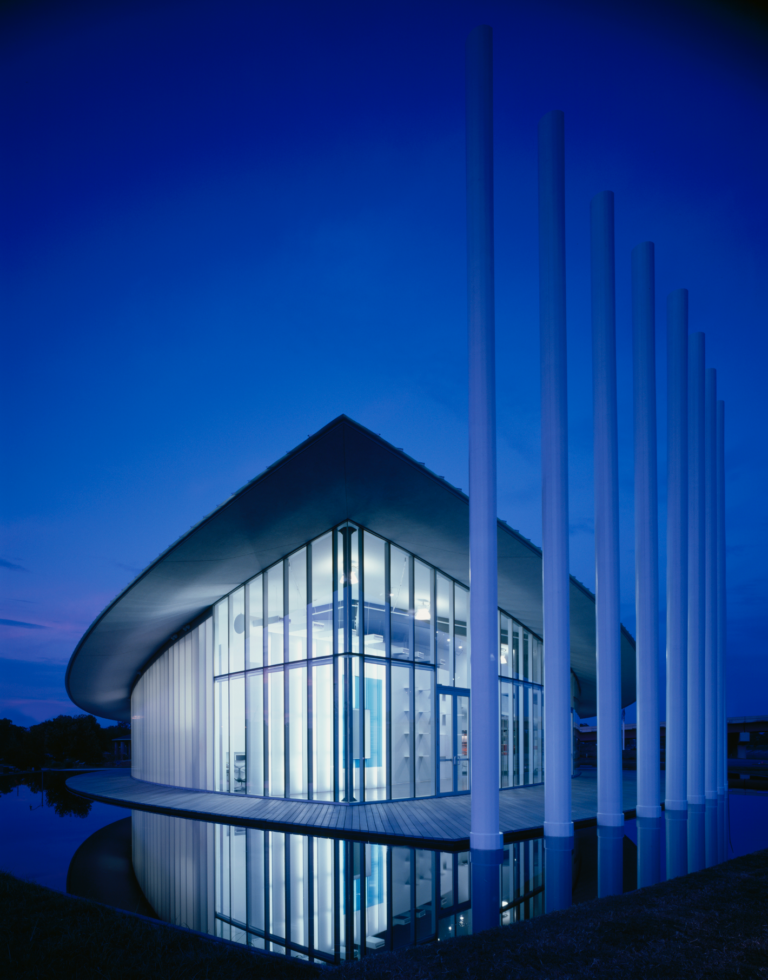
This is the two-story Mother Ship for adjacent satellites: Riversport Rapids, the Raft Pavilion, OSU Kayak Boathouse, and Rotary Point awards stage. Their lines suggest the Riversport OKC athlete’s sharp twists and turns — the aquatic equivalent of a rodeo.
Facilitating the flow of visitors, this building offers commanding views of its surroundings – Riversport OKC course, landscape, downtown skyline — as well as the river and rhythm of boathouse neighbors, their winged roofs lined up along the river’s edge, as if ready to race.
The McClendon Whitewater Center opened in 2016 as the gateway to RIVERSPORT Rapidsand adjacent satellites: the Raft Pavilion, OSU Kayak Boathouse, and Rotary Point.
Named for the Boathouse District’s greatest champion, Aubrey K. McClendon, theWhitewater Center houses an array of Guest Services (purchasing passes, merchandise,food/concessions, etc. The second-floor features office and private events.
The center offers a covered outdoor patio with views of live whitewater action (rafting/tubing and kayak slalom, surfing and shortboards). Plus, two decks with spectacular views of the Oklahoma River on one side, RIVERSPORT Rapids and OKC’s downtown skyline on the other.
Blue rafts are stowed inside one of three Raft Pavilion doors
RIVERSPORT Rapids: Roaring Success
OKC’s custom whitewater course was designed — in collaboration with Rand Elliott Architects — by the same gold-medal team that developed the 2012 London Olympics’ Lee Valley White Water Centre and the U.S. National Whitewater Center in Charlotte, North Carolina.
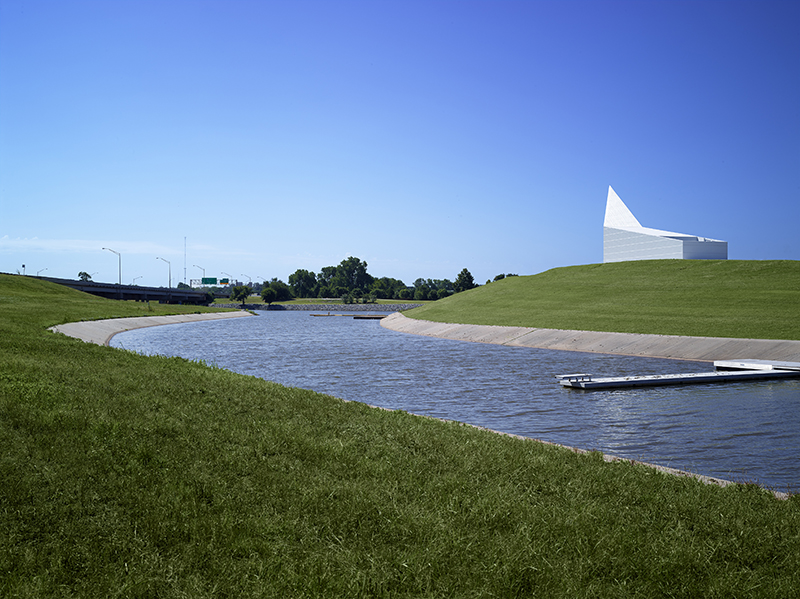
Situated Immediately south of downtown at the crossroads of I-35 and I-40, the recirculating channels of OKC’s course pump treated water to create Class II-IV rapids and offer a range of white-knuckle experiences.
The lower-flow channel offers tamer yet thrilling rafting, tubing and shortboarding – no previous experience necessary. The high-octane Class IV rapids on the Olympic-style course attract emerging and elite athletes from around the world for canoe slalom training and competition. The course has also served as a Swiftwater Rescue training center for first responders.
Spectators, meanwhile, bask in the action from the sidelines and enjoy the show. Which in 2028, will include the Olympics canoe slalom competition hosted on this course in OKC, gold medal ceremonies and all.
Blue rafts are stowed inside one of three Raft Pavilion doors
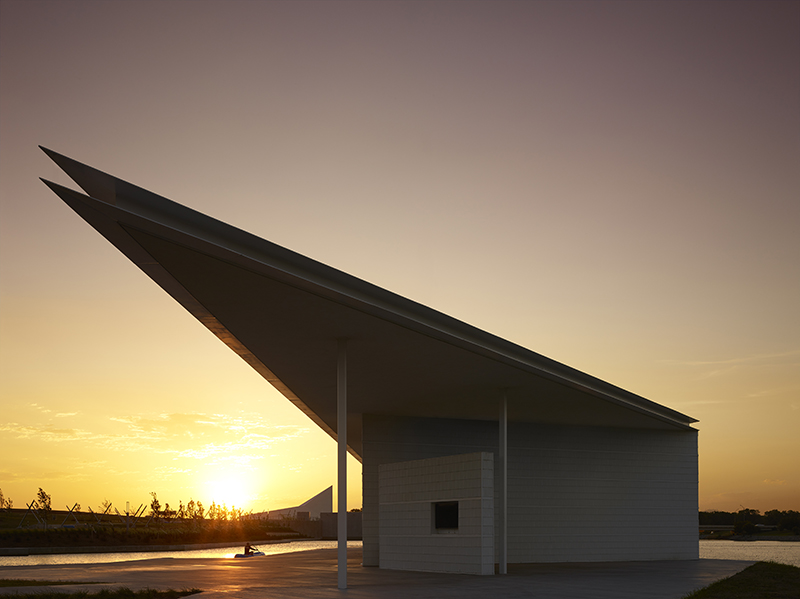
THE RAFT PAVILION
Highly visible along the river, the Raft Pavilion is multitasker: A 205-foot-long sliver of a structure for storage and rider orientation. Here, trained Riversport staff members store and distribute proper gear for rafting, tubing or kayak slalom, assisting and prepping riders.
Under its long, winged canopies, participants gather and gear up in welcome shade. (Rand Elliott Architects has made a science of proactively shielding people from a sometimes scorching Oklahoma sun.)
It’s storage for rafts, life jackets, oars, helmets, and other essentials. Stairsteps descend to rafts waiting in the water for boarding. When the gear is in use, it’s a pop-up concessions kiosk.
OSU KAYAK BOATHOUSE
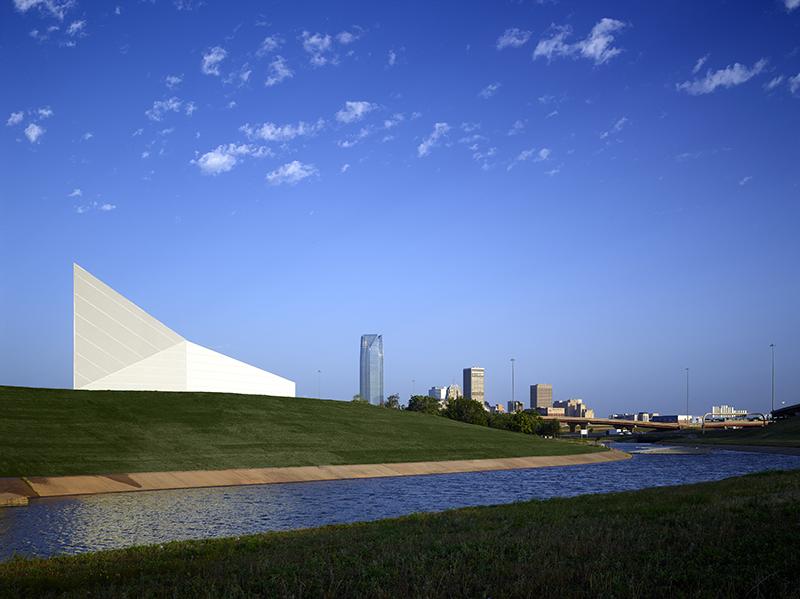
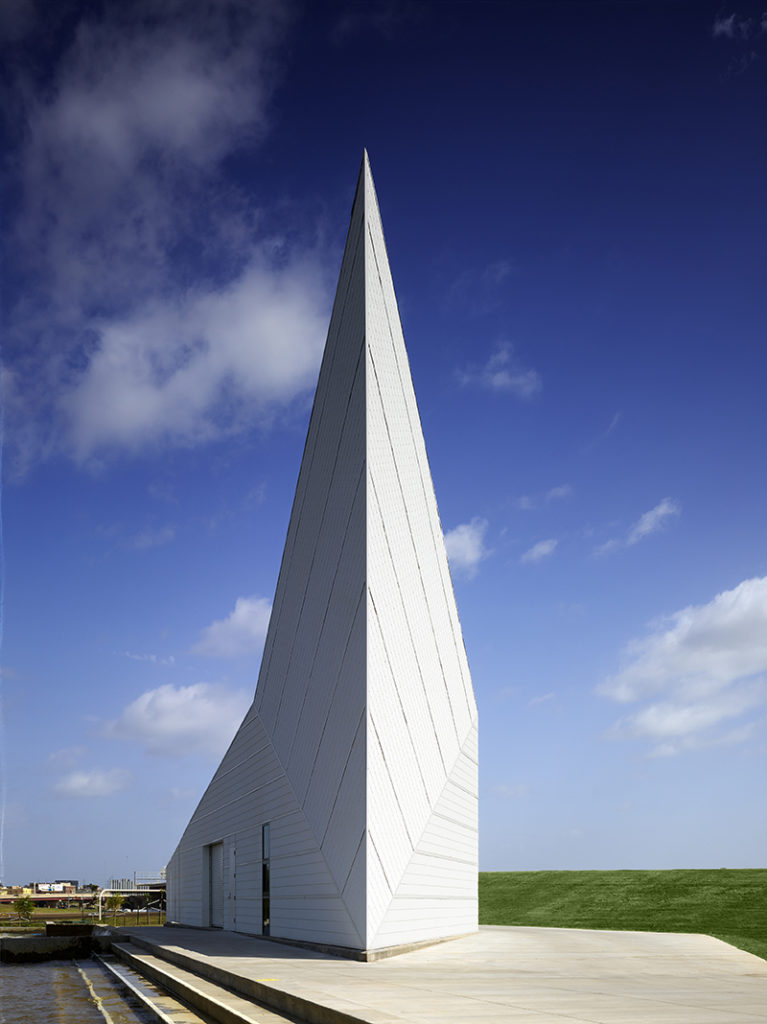
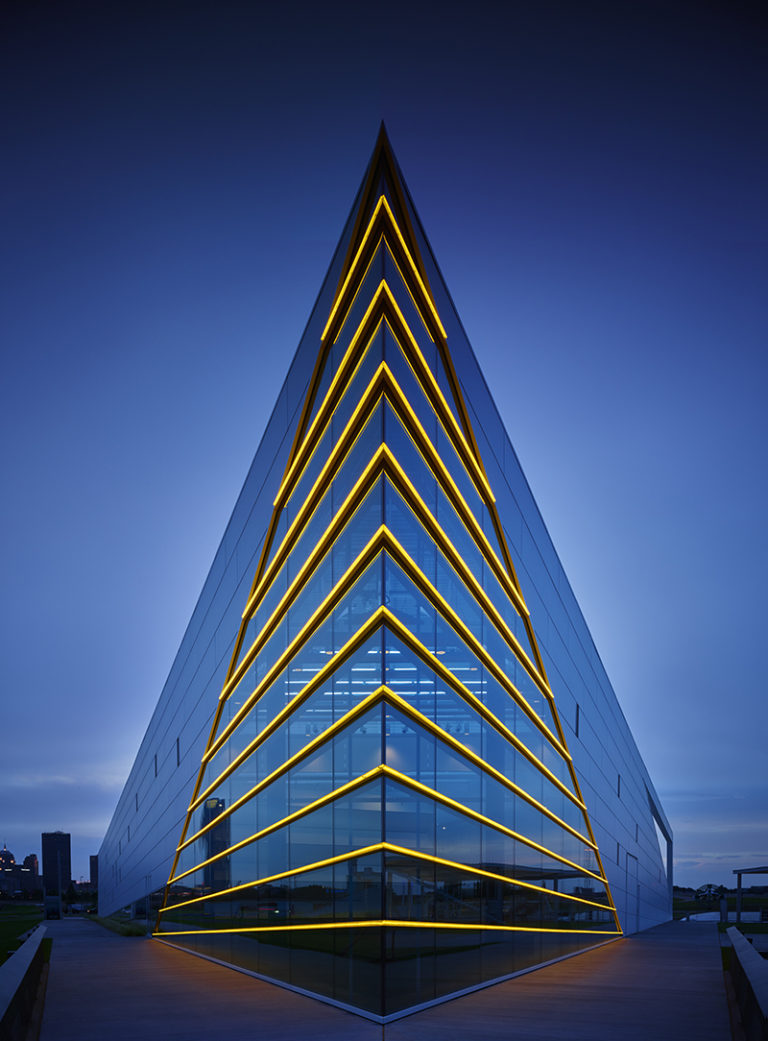
This building is a landmark on the eastern end of both McClendon Riversport OKC and Boathouse District. Its striking, sculptural shape and pristine white presence can be seen from I-35 by day or night. (Floodlit at night, it glows).
Its form is an abstraction of a kayaker in a frozen, twisting moment. It serves as storage and a staging location for competitive events and training, including Swiftwater skills for first responders. It also serves, we think, as sculpture.
In 2016, OSU’s then-president, Burns Hargis, saw it made sense to partner with the Boathouse District to recognize Mike and Tempe Knopp — the rowing enthusiasts who founded the rowing organization, OAR (Oklahoma Association of Rowers). As recent OSU grads, the Knopps were first to recognize OKC’s new urban river as a rowing venue. (Burns has always been ready to note that Rand Elliott is also an architecture graduate.)
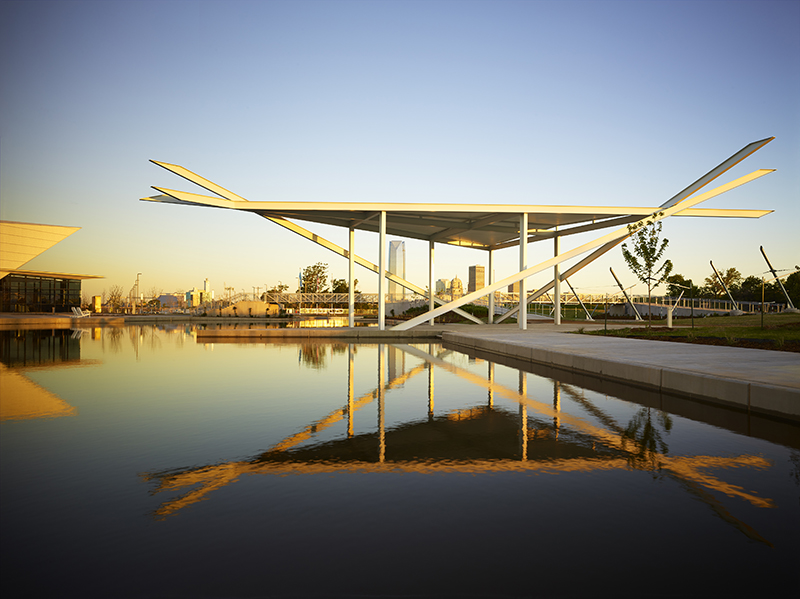
ROTARY POINT
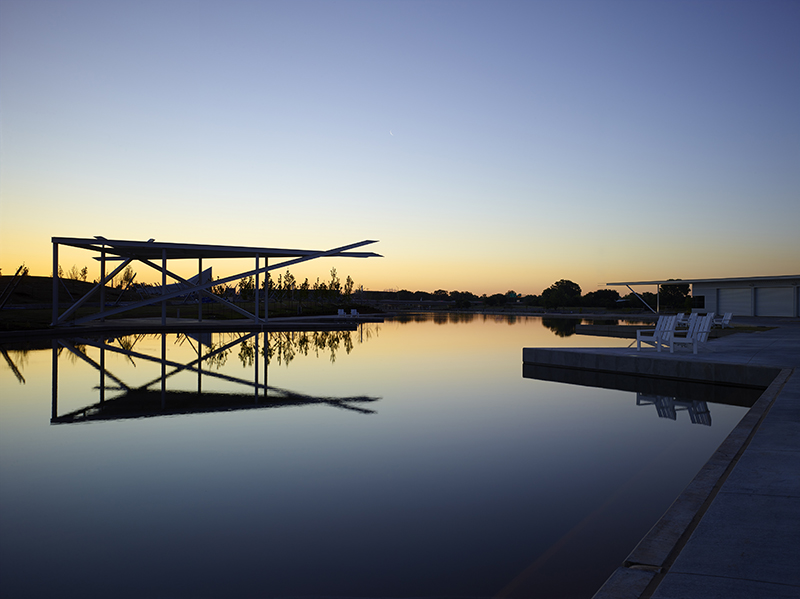
Any sports stadium needs an awards stage for the ceremony of victory. Rotary Point awards stage (a project of Downtown OKC’s Rotary 29), a series of steel beams delicately meet to form and define space, seemingly afloat in water. The triangular form is reinforced in three dimensions with overlapping diagonal bracing and a translucent fabric roof.
The architectural lines hint at the mad paddling action of oars and paddles to create sculpture that salutes the action of a helter-skelter sprint.
As another iconic centerpiece of the McClendon Riversport OKC complex, it serves special programs for schools, community groups and musical performances, as well as canoe/kayak competitors.
SPECTATOR BRIDGES
The bridges that span the course and connect the venue’s capabilities are similar in material and design to the other buildings and pavilions. These simple, geometric, ADA-compliant forms feature spectacular views of the area, including the downtown skyline and Riversport OKC action below.
ONWARD AND UPWARD
OKC’s flatwater stadium had become the stage for international championships and Olympic Team Trials, most recently in 2024. But few might have dared imagine this city hosting actual Olympic Games and Gold Medal ceremonies?
The Oklahoma River has long been called a “Cinderella River.” And this river’s going to the Ball!